Selection Guide to Industrial Acoustic Cameras: 10 Technical Criteria
Multimodal Analysis and Ultrasonic Diagnostics: A Critical Guide to Selecting Industrial Acoustic Cameras
Technical Introduction
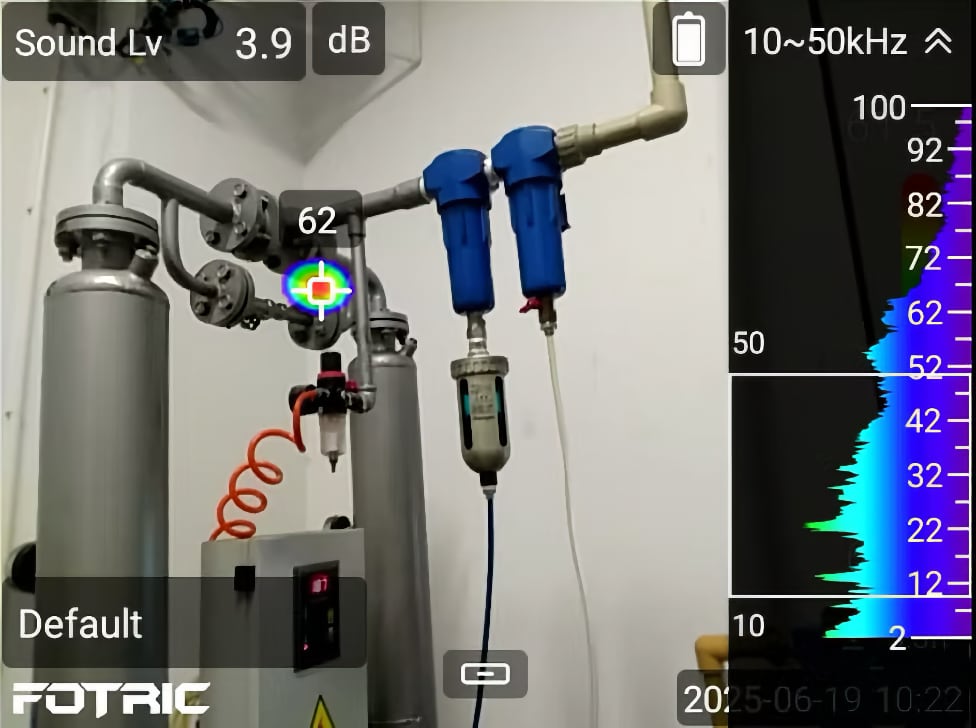
The evolution of predictive maintenance and critical infrastructure monitoring has found a disruptive tool in acoustic cameras (or Acoustic Imagers). Based on Beamforming technology, these solutions allow real-time visualization of complex acoustic phenomena, transforming sound pressure gradients into two-dimensional heat maps overlaid on the optical field.
However, the effectiveness of an acoustic camera does not depend solely on its ability to "see" sound, but on the synergy between sensor architecture, the processing power of filtering algorithms, and frequency domain management. In industrial contexts characterized by high levels of background noise, the main challenge lies in the instrument's ability to discriminate weak signals—such as turbulence induced by micro-leaks or early partial discharges—from the stationary acoustic emissions of operating machinery. This application note analyzes the fundamental engineering parameters that determine the spatial resolution, sensitivity, and diagnostic reliability of a microphone array, providing the necessary criteria to select the most suitable technology between latest-generation MEMS sensors and high-dynamic piezoelectric transducers.
1. Number of Microphones
The number of sensors (MEMS) is the heart of the camera. The more microphones present, the greater the acoustic gain and the ability to distinguish weak signals from background noise.
Why it matters: A high number (e.g., 124 microphones) allows for the detection of tiny air leaks at greater distances.
Real-world example: In a noisy power plant, a camera with many microphones can isolate the hiss of a hydrogen leak despite the roar of the turbines.
2. Frequency Range (Bandwidth)
Human hearing reaches 20 kHz. Acoustic cameras often operate between 2 kHz and 100 kHz.
Why it matters: Gas and compressed air leaks generate turbulence that emits ultrasound (20-40 kHz). Partial discharges in electrical components can reach even higher frequencies.
Real-world example: For vacuum leak detection in a chemical plant, it is essential that the camera can "see" beyond 30 kHz.
3. Detection Range
Not all cameras "see" at the same distance. This depends on sensor sensitivity and processing algorithms.
Why it matters: It allows for the inspection of overhead lines, warehouse roofs, or hazardous areas without the need for ladders or lift platforms.
Real-world example: Inspecting insulators on high-voltage lines at a distance of 50 meters to identify the corona effect.
4. Microphone Arrangement (Array)
The shape of the array (circular, spiral, or "snowflake") and its diameter influence the precision with which the camera locates the source.
Why it matters: A larger diameter improves spatial resolution, preventing two nearby sound sources from appearing as a single blurred "spot".
Real-world example: Exactly locating which bearing is failing in a row of closely spaced motors.
5. Resolution and Visual Overlay
The sound map (heat-map) is overlaid on an optical image.
Why it matters: If the overlay is inaccurate or the optical resolution is low, you might identify the wrong component.
Real-world example: Precisely identifying a loose connector inside a complex and crowded electrical panel.
6. Signal-to-Noise Ratio (SNR)
Indicates the instrument's ability to extract useful information from ambient noise.
Why it matters: In a machine shop, machinery noise can "blind" an inexpensive camera. A high SNR ensures that only the defect is displayed.
7. Integrated Analysis and Reporting
Many modern cameras do not just show a colored spot but quantify the problem.
Why it matters: Transforming a sound into an economic value (e.g., "this leak costs you €1,500 per year") facilitates the prioritization of interventions.
Real-world example: Automatic generation of a PDF report listing all compressed air leaks found during an inspection shift.
8. Portability and Ergonomics
Inspections can last for hours. A heavy or unbalanced device fatigues the operator.
Why it matters: One-handed use allows for holding onto handrails or moving safely between machinery. Battery life must cover at least one work shift.
9. Robustness (IP Rating)
Industrial environments are dirty, dusty, and sometimes damp.
Why it matters: An IP54 rating ensures the instrument won't fail if used in light rain or in an environment with metal dust.
Real-world example: Predictive maintenance in a steel mill or paper mill, where dust and heat are constant.
10. Ease of Use (Interface)
A tool that is too complex will end up not being used.
Why it matters: Functions like "dynamic threshold" or automatic filtering of irrelevant frequencies allow even a non-expert operator to achieve professional results.
Real-world example: A maintenance technician who can learn to use the tool in just 15 minutes of training.
The choice between MEMS and Piezoelectric sensors defines the instrument's architecture and analysis capability.
Here are the main differences explained simply:
1. MEMS (Micro-Electro-Mechanical Systems)
Advantages:
- Microscopic size: Allows hundreds of sensors to be mounted in a small space.
- Consistency: Being produced on silicon wafers, all microphones in the array have nearly identical responses (crucial for sound map precision).
- Cost: Very economical, allowing for the creation of dense arrays (over 100 microphones) without prohibitive costs.
Disadvantages:
- AOP (Acoustic Overload Point): Can distort if exposed to extremely loud sounds at close range.
Application: Ideal for compressed air leaks and partial discharges in industrial settings, where many sensors are needed to isolate faint hisses in noisy environments.
2. Piezoelectric (PZT)
Advantages:
- Extreme robustness: Resists shocks, vibrations, and temperatures that would destroy a MEMS chip.
- High Dynamic Range: Can measure extremely high sound pressure levels (SPL) without distorting.
- Linearity: Offers a very faithful response for scientific and laboratory analysis.
Disadvantages:
- Bulk and Weight: Larger and heavier than MEMS. Difficult to create arrays with more than 32-48 sensors in a handheld tool.
- Cost: Significantly higher per single unit.
Application: Perfect for wind tunnel testing in automotive or for measuring explosions and high-intensity impact noise in the defense sector.
The selection of an acoustic camera must balance analytical capability and field operability. While sensor architecture defines raw data precision, processing software and ergonomics transform that data into immediate actionable insights. Investing in technology with advanced classification algorithms and robust hardware optimizes energy efficiency and safety, evolving maintenance strategies toward a truly predictive model.










Leave a Comment