
-
Twój koszyk jest pusty!

Twój koszyk jest pusty!
Moku Version 3.3 brings a new Neural Network instrument to Moku:Pro that enables users to implement artificial neural networks for fast, flexible signal analysis, denoising, sensor conditioning, closed-loop feedback, and more. If you are unfamiliar with the basics of a neural network or want to know how one can benefit your research and development goals, read on to explore real-life applications and tutorials.
First, it's important to note that "artificial neural network" (ANN) is the more accurate term for these systems, since they are software-based, rather than biological neurons. With this clarification in mind, we will use the term "neural network" to refer to an ANN. For this introduction, we'll consider only fully connected neural networks, rather than complicated setups such as convolutional, recurrent, and transformer architectures.
Neural networks are composed of nodes, organized into layers. The value of a node depends on the value of one or more nodes from the previous layer. The nodes from the first (input) layer take their value directly from external input, while the nodes in the final (output) layer give the network's result. The layers between input and output are referred to as hidden layers.
In mathematical terms, imagine the input layer as an N ✕ 1 matrix, where N is the number of nodes in the input layer and each element in the matrix corresponds to the activation value, as shown in Figure 1.

Figure 1: Neural network architecture, showing input, hidden, and output layers.
Next are the hidden layers. The number of hidden layers and nodes within them depends on the complexity of the model and available computational power. The activations in the hidden layers are calculated using a combination of the activations from the previous layer, with each node applying different weights and biases to the input layer values. This is shown in linear algebra terms in Figure 2.
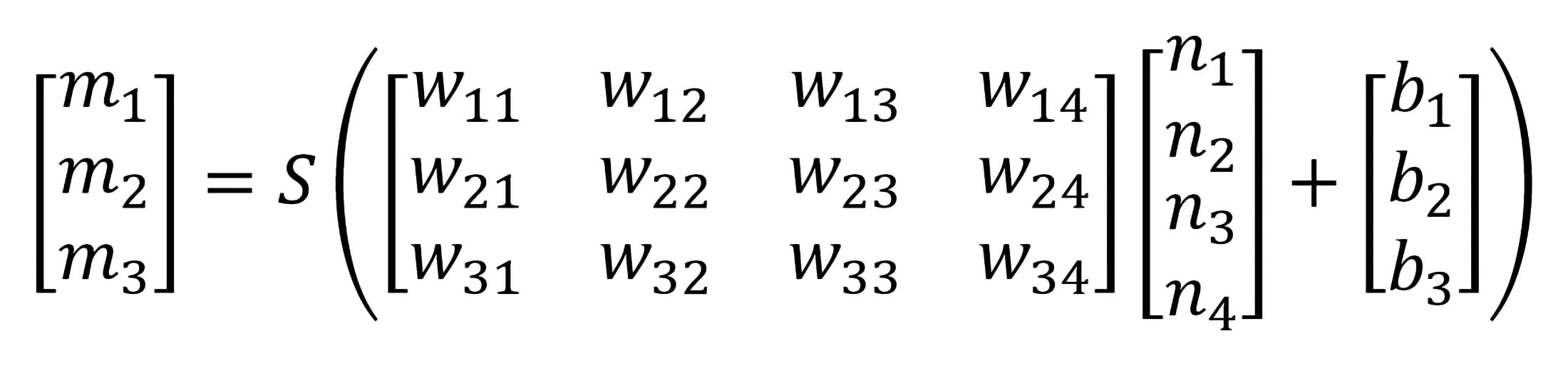
Figure 2: The activations in the hidden layers are calculated using a combination of the activations from the previous layer.
If the input layer is an N ✕ 1 matrix (n1, n2...), the next activations are obtained by multiplying this with an M ✕ N matrix, where M is the number of nodes in the hidden layer. Each element in the matrix is a weight represented by wmn, meaning that MN parameters are needed for each layer. The result is an M ✕ 1 matrix, which is then offset by a bias value (b1, b2...). After calculating the new activations, they are passed through an "activation function". The activation function can provide nonlinear behavior such as clipping and normalizing, making the network much more powerful than it would be if it were simply a series of matrix multiplications.
After passing through several hidden layers, the data finally arrives at the output layer. In the output nodes, the value of the activation corresponds to some parameter of interest. As an example, suppose that time series data collected from an oscilloscope is fed into the input, and the goal of the network is to classify the signal as a sine wave, square wave, sawtooth wave, or DC signal. In the output layer, each node would correspond to one of these options, with the highest value activation representing the network's best guess as to the form of the signal. If one activation is close to 1 and the others are close to 0, the confidence of the network's guess is high. If the activations are similarly valued, this indicates low confidence in the answer.
How do neural networks work?
Without adjusting the weights and biases of the hidden layers, a neural network ends up being nothing more than a complex random number generator. To improve the accuracy of the model, the user must provide training data, where both the input dataset and expected answer are known. The model can then calculate its own answer to the training set, which can be compared to the true value. The calculated difference, known as the cost function, gives a quantitative assessment of the model's performance.
After calculating the cost function for a given dataset, the weights and biases of the hidden layers can then be adjusted through various calculus operations, with the goal of minimizing the cost function. This is similar to the concept of gradient descent in vector calculus and can be explored further in literature. This process, called backpropagation, allows information obtained via the cost function to work backward through the layers, resulting in the model learning, or adjusting itself, without human input.
Training data is often run through the neural network multiple times. Each instance of this data being provided to the model is known as an epoch. Typically, some training data will be reserved for validation. In validation, a trained network is used to infer outputs from this reserved data set and its predictions compared to the known correct output. This gives a more accurate picture of the model's performance than the cost function value alone, as it indicates how well the model can generalize results to new and novel inputs.
What are the different types of neural networks?
Neural networks, while operating on similar principles, can take various forms depending on the application. A few common neural network examples include:
How are neural networks used in signal processing?
While neural networks are popular for things like powering large language models, deciphering images, and translation, they are also incredibly useful for signal processing. A few examples where machine learning can improve a measurement setup include:
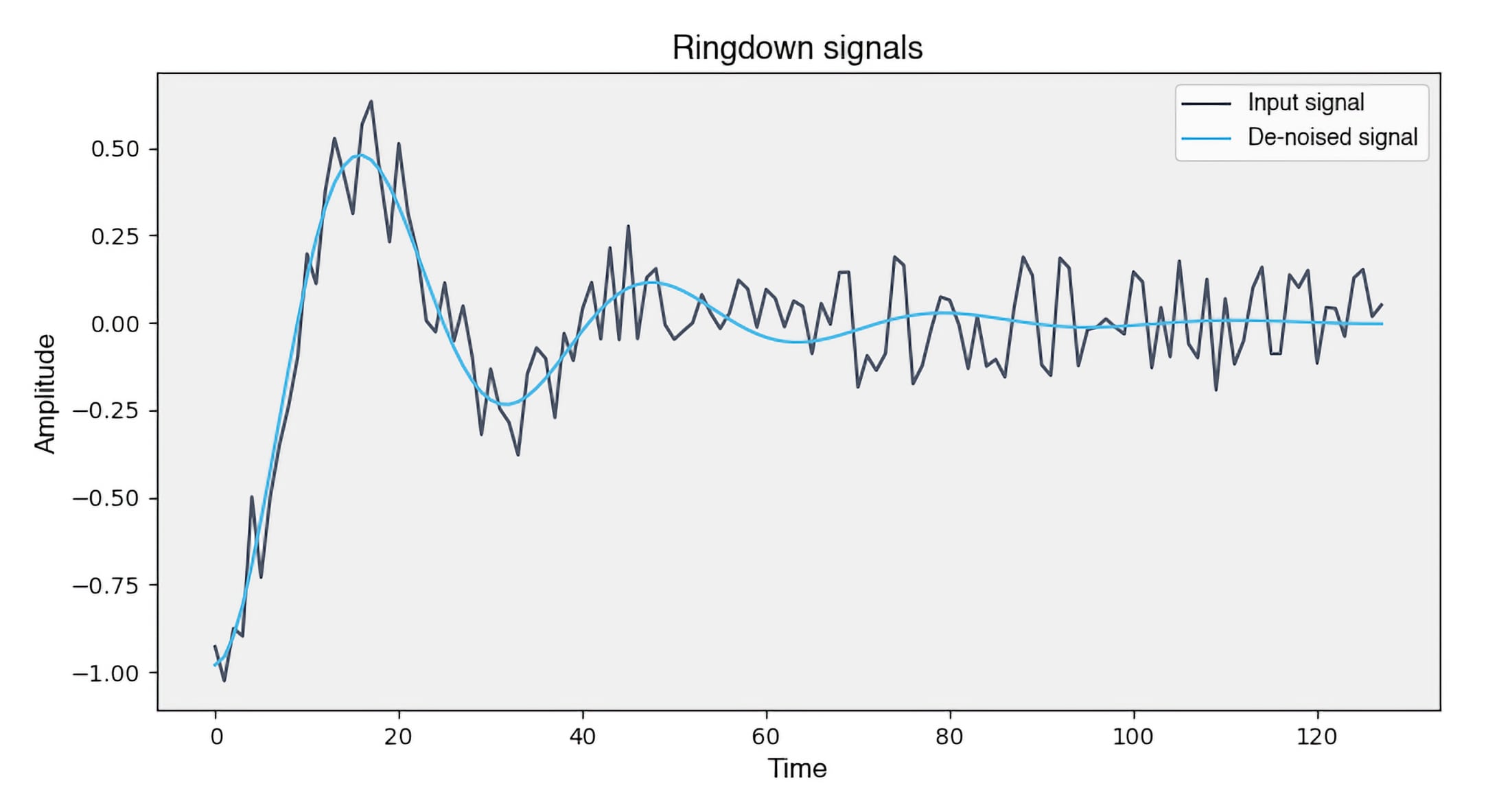
Figure 3: A reconstructed, denoised signal after being fed through a neural network.
What are the benefits of an FPGA-based neural network?
Neural networks are typically built and run on combinations of CPUs and/or GPUs. This approach gives incredible computing power, but it is also resource intensive. Large AI models are energy hungry and often excessive for the types of signal processing applications previously mentioned.
FPGAs, by comparison, are not as intrinsically powerful as high-end computers. However, their flexibility makes them strong candidates for implementing small-scale neural networks. Their parallel processing capability benefits the linear algebra and other complex mathematics involved in the forward and backward propagation of information through the network.
FPGA-based neural networks are ideal for experimental situations, as their speed in handling real-time data enables rapid control and decision-making, without having to communicate with a host PC. FPGAs are also reconfigurable, so the user can quickly configure the neural network to their own needs. Lastly, given their compact size, neural networks implemented on FPGAs can help reduce resource and energy consumption.
What is the Moku Neural Network?
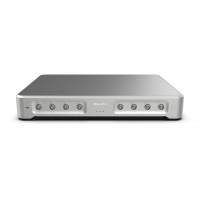
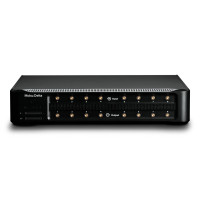
In addition to a reconfigurable suite of fast, flexible, FPGA-based test and measurement instruments, Moku:Pro now offers the Moku Neural Network. Benefiting from the versatility and fast processing speed of FPGAs, the Neural Network can be used alongside other Moku instruments such as the Waveform Generator, PID Controller, and Oscilloscope in applications such as signal analysis, denoising, sensor conditioning, and closed-loop feedback.
You can use Python to develop and train your own neural networks and upload them to Moku:Pro using the Moku Neural Network in Multi-instrument Mode. This allows for analysis of up to four input channels, or one channel of time series data, and up to four outputs for processing experimental data in real time - all on Moku:Pro. The Moku Neural Network features up to five dense layers of up to 100 neurons each, and five different activation functions depending on your application.
If you're interested in seeing how the FPGA-based Moku Neural Network can benefit your research, check out this step-by-step tutorial. This guide walks through all the basics, including Python installation, Moku Neural Network construction and training, and implementation. If you're already familiar with the fundamental concepts of a neural network, you can find advanced, ready-to-use examples here.











Leave a Comment