There are several kinds of electrical (or “electronic”) tests that can require data centers, especially when testing power, energy efficiency, or electrical infrastructure performance at large scale.
Here’s how electrical testing connects to data centers:
1. Power Load Testing
- Purpose: To ensure the data center’s power systems (UPS, PDUs, generators, etc.) can handle peak loads safely.
- How it works:
- Engineers use load banks (devices that simulate electrical load) to test how power equipment behaves under real conditions.
- Often done before bringing servers online or during maintenance.
- Example: Testing a 5 MW data center’s backup generators under full simulated IT load.
2. UPS and Battery Testing
- Purpose: To verify that Uninterruptible Power Supply (UPS) systems and battery backups will provide stable power during outages.
- Why it’s critical: Data centers must run 24/7, even during grid failures.
- Tests include:
- Battery discharge tests
- Transfer time tests (to backup power)
- Runtime validation
3. Electrical Redundancy and Failover Tests
- Purpose: To ensure redundant power paths (A/B feeds) work as expected.
- Typical test: Simulate failure of one power feed to confirm servers switch seamlessly to the other.
- Outcome: Confirms the reliability of Tier III and Tier IV data center designs.
4. Power Quality and Thermal Testing
- Purpose: To measure voltage stability, harmonics, and power factor, as well as heat output from electrical systems.
- Tools used: Power analyzers, oscilloscopes, infrared cameras.
- Why: Poor power quality can damage servers or reduce efficiency.
5. Electrical Commissioning Tests
- Purpose: Comprehensive testing during data center construction or upgrades.
- Includes:
- Grounding and bonding checks
- Breaker coordination studies
- Short-circuit and insulation resistance testing
- Goal: To verify all electrical systems meet design specs and safety codes before going live.
6. Energy Efficiency and Sustainability Testing
- Purpose: To measure PUE (Power Usage Effectiveness) and optimize energy consumption.
- Why it matters: Modern data centers aim for low PUE (<1.3).
- Tests include: Monitoring power distribution, cooling loads, and renewable energy integration.
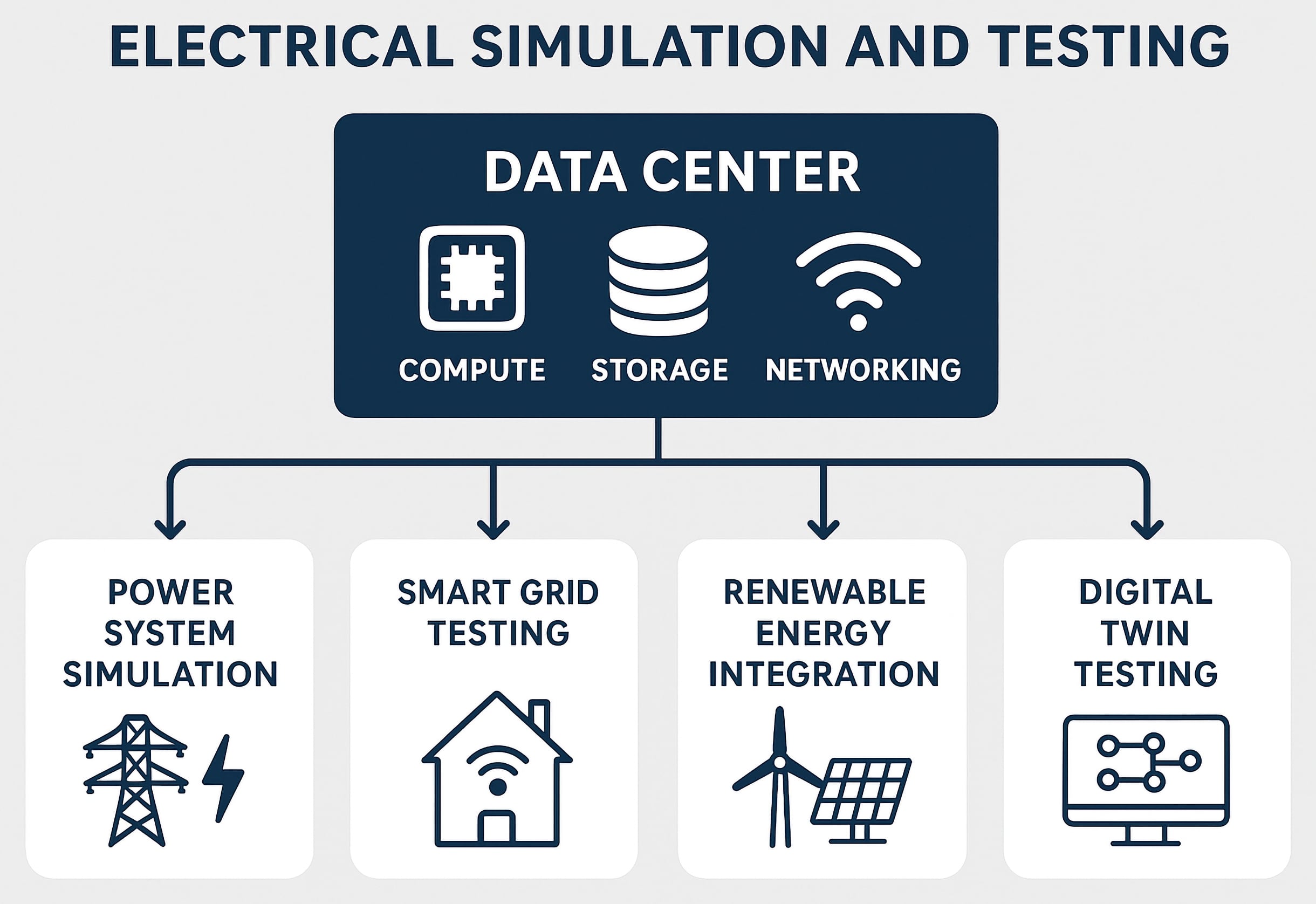
Electrical system testing and simulation that uses a data center’s computing power.
1. Power System Simulation & Analysis
What it is:
Data centers are used to run large-scale simulations of electrical networks — like national power grids, microgrids, or industrial power systems.
Why it needs a data center:
- Huge computational requirements (thousands of nodes, time-domain analysis).
- Real-time or near-real-time modeling.
- Integration of renewable sources and distributed energy resources (DERs).
Examples:
- Grid stability simulations: Testing how the grid reacts to faults or load spikes.
- Short-circuit and protection coordination: Ensuring relays and breakers trip correctly.
- Transient analysis: Studying voltage or frequency fluctuations after disturbances.
Tools/software often run in data centers:
PSCAD, PSS®E, DIgSILENT PowerFactory, OpenDSS, GridLAB-D, MATLAB Simulink.
2. Smart Grid and Demand Response Testing
What it is:
Simulating millions of connected devices — homes, EVs, solar panels, smart meters — to test grid communication, control, and optimization.
Why it needs a data center:
- Simulating IoT-scale interactions across large power networks.
- Real-time optimization of energy flows using AI or machine learning.
- Data ingestion from sensors and field devices.
Examples:
- Testing automated demand response (ADR) under peak conditions.
- Simulating a citywide EV charging impact on grid stability.
- Validating microgrid controllers in virtual environments.
3. Renewable Energy Integration Testing
What it is:
Using HPC clusters in data centers to model how solar, wind, and storage units interact with existing grids.
Why it needs a data center:
- Complex weather and generation forecasting models.
- Hybrid energy system optimization (solar + wind + battery + diesel).
- Requires high-fidelity simulations and AI-based predictive control.
Examples:
- Running energy forecasting algorithms on historical weather + production data.
- Hybrid plant control testing using digital twins.
4. Digital Twin Testing for Electrical Infrastructure
What it is:
Creating a digital replica (digital twin) of a physical electrical network or power plant, then testing new configurations virtually.
Why it needs a data center:
- Constantly updating data streams (IoT, SCADA, sensors).
- Machine learning models for predictive maintenance.
- Real-time co-simulation between electrical and mechanical systems.
Examples:
- Testing how an industrial plant reacts to a motor failure before it happens.
- Optimizing transformer load distribution virtually.
5. Cybersecurity Testing for Power Systems
What it is:
Simulating and testing cyber-physical attacks on smart grids and substations in a controlled environment.
Why it needs a data center:
- Need to emulate both IT (network) and OT (control) systems.
- Run large-scale penetration tests safely.
- Analyze big telemetry datasets for anomaly detection.
Examples:
- Testing resilience of SCADA systems.
- Running AI-based intrusion detection algorithms for power networks.
6. Energy Market Simulation and Optimization
What it is:
Running computational models to test electricity pricing, trading, and dispatch strategies under various conditions.
Why it needs a data center:
- Involves massive optimization problems (economic dispatch, unit commitment).
- Integration of renewable and distributed sources increases complexity.
- Requires real-time or near-real-time computation.
Examples:
- Testing new wholesale electricity market algorithms.
- Simulating carbon pricing or grid congestion effects.
Summary Table
| Power System Simulation |
Study grid stability & faults |
HPC for large-scale physics models |
| Smart Grid Testing |
IoT-scale control simulation |
Massive data + real-time computation |
| Renewable Integration |
Forecast + optimize hybrid systems |
AI and weather simulation workloads |
| Digital Twin Testing |
Virtual validation of electrical assets |
Continuous data streaming + ML |
| Cybersecurity Testing |
Grid attack resilience |
Safe, scalable simulation |
| Energy Market Simulation |
Optimize economics of grid ops |
Complex optimization + large data |
Visual workflow










Leave a Comment