Saleae Logic Analyzers include Saleae Logic 8 which offers 8 channels, 25 MHz digital bandwidth and 100 MS/s sampling rate, Saleae Logic Pro 8 and Saleae Logic Pro 16 that provide 8 and 16 channels respectively, with 100 MHz digital bandwidth and 500 MS/s sampling rate.
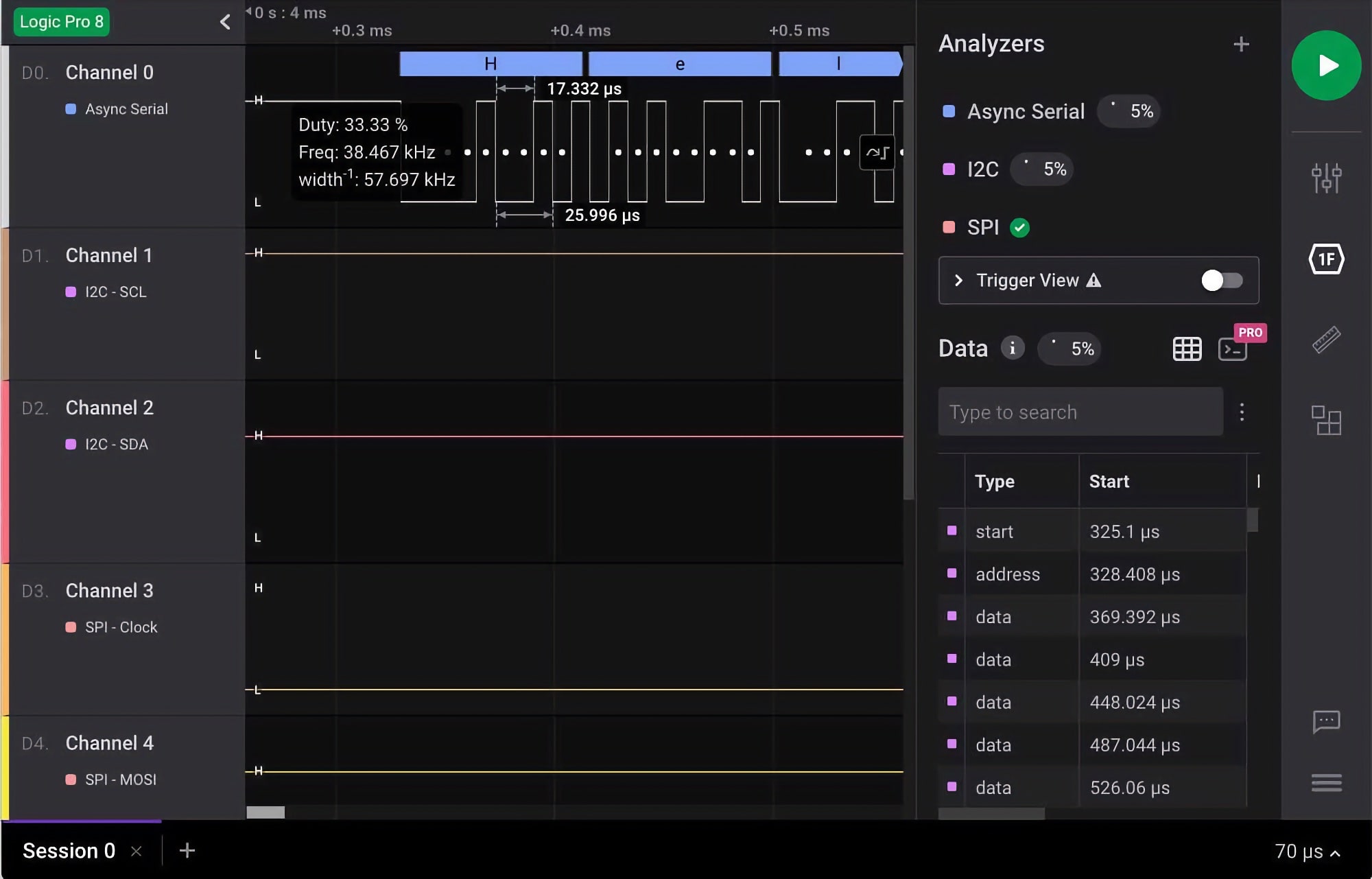
Effortlessly decode protocols like SPI, I2C, Serial and many more. Leverage community created analyzers or build your own low-level or high-level protocol analyzer.
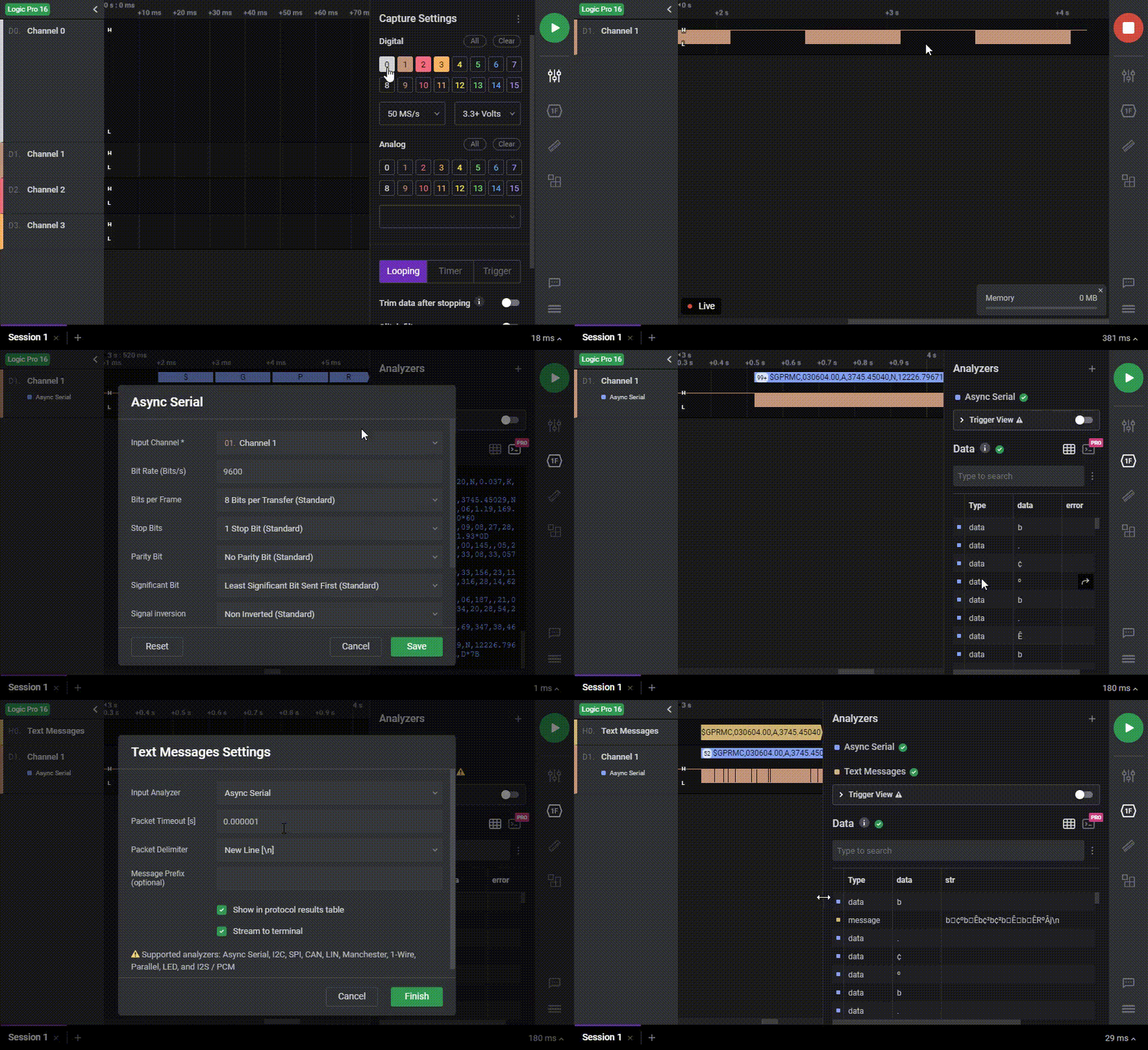
Debugging that just works. Stable, easy to use, and fully cross platform, Logic 2 makes it dirt simple to capture, visualize, and search your signals.
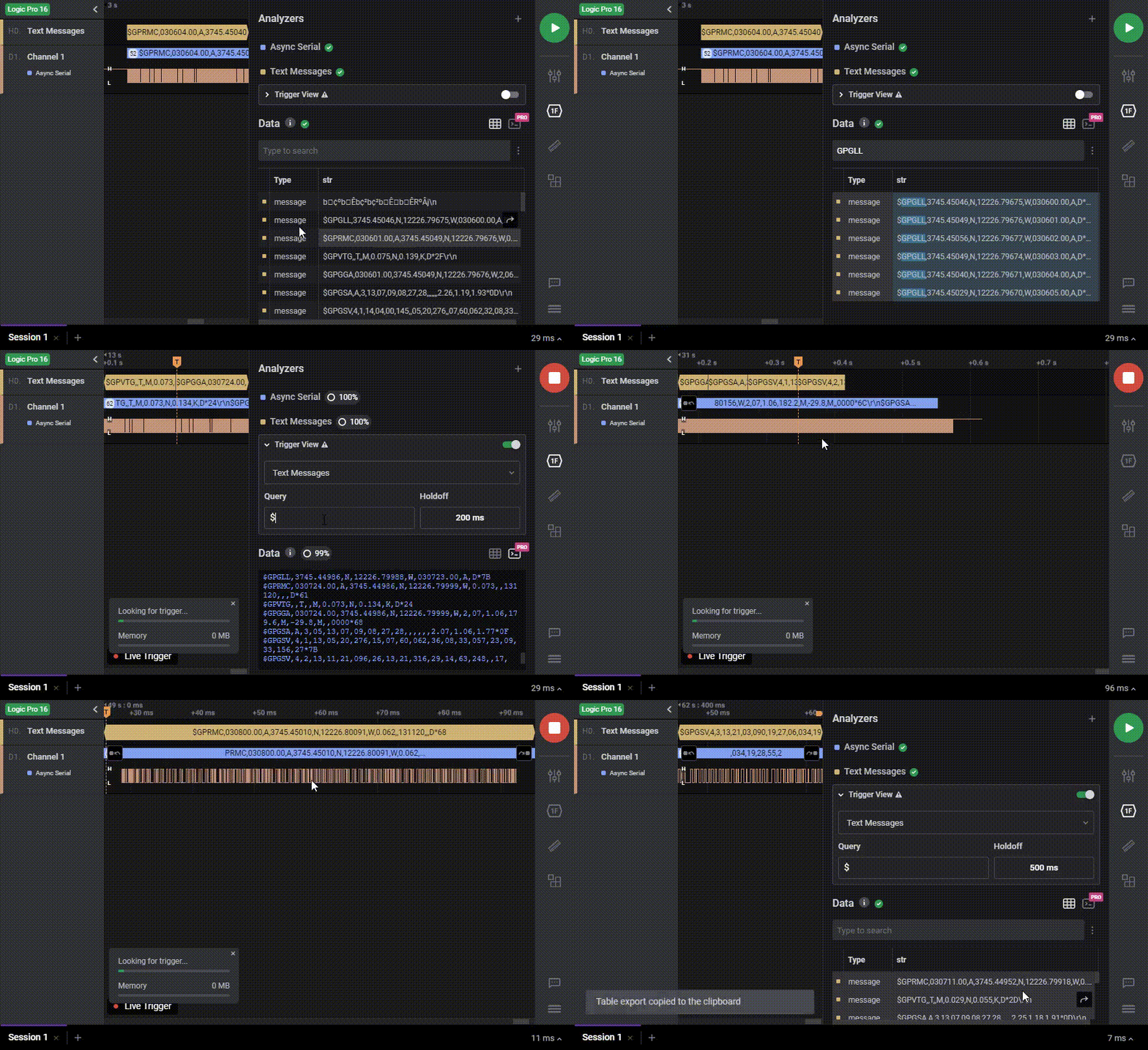
Explore your board-level comms interactively with Live Trigger on Protocol and Protocol Search. Unlike a scope, all your traffic is being recorded — you can always stop and analyze exactly what happened and why.
Verify behavior instantly with measurements wherever you point your mouse. You can even create your own measurements or use ones from the community.
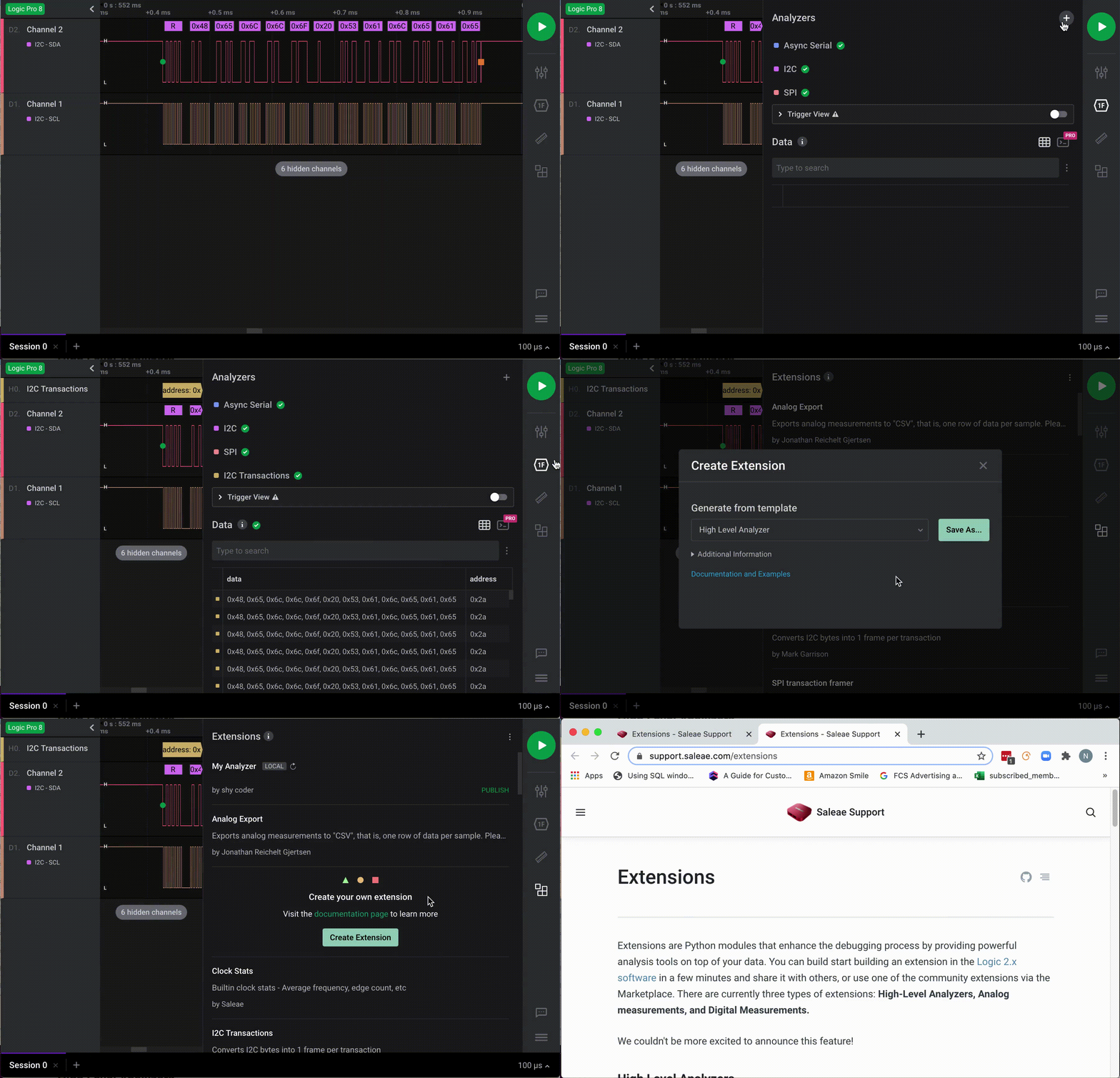
Take on any comms challenge by creating your own low-level protocol analyzer, high-level protocol analyzer, or measurement. And if you like, you can easily share your extension with the Saleae community.
Craftsmanship
Saleae really cares about this stuff. And they think that when you get Logic in your hands, you’ll be able to tell.
Machined Aluminum
Every Logic starts as extruded 6061 T6 aluminum plate. It is then precisely machined with a 3-axis CNC mill, using four different setups and seven different solid carbide tools.
Metal Finishing
The machined enclosure is cleaned and then textured with a light glass bead blast to give it a uniform, elegant look. Next the part is anodized, brightened, colored and sealed. This is the finish quality you would expect from pro-audio equipment or a new MacBook.
RGB LED
Choose your favorite color to customize your Logic. The brightness is controlled by PWM, and Saleae has RC-filtered the PWM so the LED does not contribute any measurable degradation to your signals.
Low-jitter ADC clock
The low jitter of the ADC sampling clock assures the SNR is not degraded.
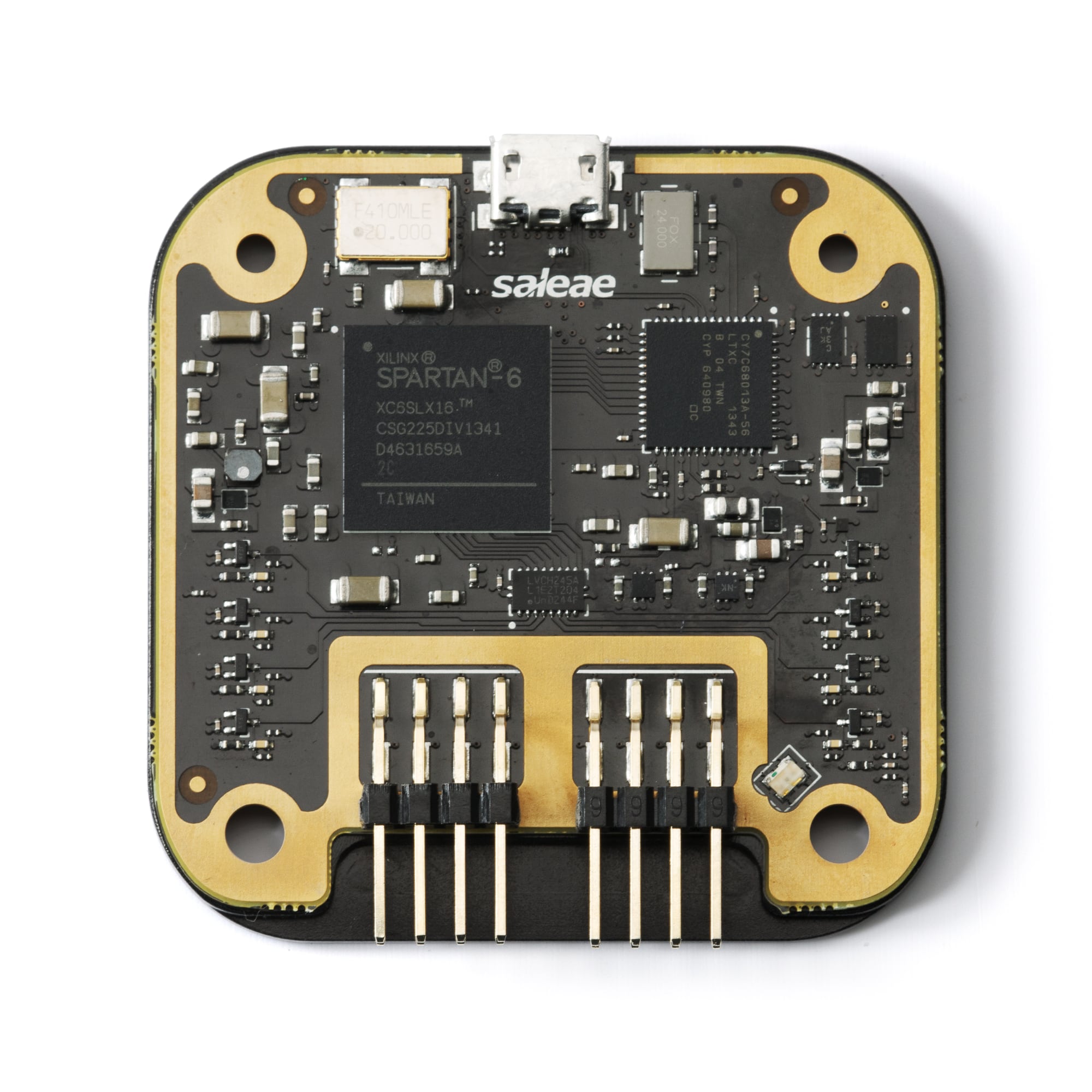
FPGA Logic 8, Logic Pro 8 and Logic Pro 16 feature the Xilinx Spartan 6 FPGA, which interfaces to the ADC, digital inputs, and USB bridge. The FPGA also has the capability of performing over 5 billion DSP operations per second (over 10 billion on Pro 16). When you use more analog channels than can be streamed over USB at once, it's needed to filter and decimate that data in the FPGA – reducing the bandwidth without introducing aliasing. Logic Pro 16 produces analog data at a rate of 9.6Gbit – that’s a lot of data to process in real time!
PCB
PCB assembly is performed in Fremont, California. Logic 8 is 8-layer, and Logic Pro 8 and 16 have, well, more layers than that.
Dual-Use Inputs and Signal Integrity
To provide optimal signal integrity with a flying lead test probe, each input has a dedicated ground wire. In most situations, users can leave extra grounds disconnected. In addition, on Logic 8, Logic Pro 8 and Logic Pro 16, each input can be configured to be an analog input, a digital input, or both at the same time.
ADC Logic 8 and Logic Pro 8 have a 8-channel ADCs (Analog-to-Digital Converter), while Logic Pro 16 has two. Logic 8 has an analog sample rate of 10MS/s at 10-bits, and Logic Pro 8 and Pro 16 sample at 50MS/s at 12-bits. For Logic Pro 16, this is an awesome 9.6Gbit of data which must be handled by the FPGA. When you use more channels than USB can handle, the FPGA filters and decimates the data in real time so that the resulting signal does not exhibit any aliasing from frequencies above the new bandwidth. The low jitter of the ADC sampling clock assures the SNR is not degraded.
Anti-aliasing Filters
An anti-aliasing filter prevents frequencies higher than the Nyquist frequency from being sampled. Any frequency content higher than Nyquist will result in aliasing, which, generally speaking, makes it impossible to compute an accurate FFT (Fast Fourier Transform). Filters can have an adverse effect on both gain and phase so this must be carefully accounted for.













Leave a Comment