Regulation (EU) 2023/1804, better known as AFIR (Alternative Fuels Infrastructure Regulation), represents the infrastructural pillar of the "Fit for 55" package. Unlike the previous directive (AFID), AFIR is a directly applicable regulation in all Member States, eliminating national legislative fragmentation.
2027 is a watershed year: by January 1st of that year, critical obligations regarding retrofitting, price transparency, and new communication standards for charging infrastructures will come into effect.
1. Power Targets and Geographical Coverage (2025-2027)
AFIR imposes targets based on the active vehicle fleet and distance along the Trans-European Transport Network (TEN-T).
Light-Duty Vehicles (LDV - Cars and Vans)
Fleet requirement: Member States must ensure 1.3 kW of public power for every registered battery electric vehicle (BEV) and 0.8 kW for every plug-in hybrid vehicle (PHEV).
- TEN-T Core Network (by end of 2025): Charging pools every 60 km with a total power of at least 400 kW (including at least one 150 kW point).
- TEN-T Core Network (by end of 2027): The total pool power must increase to 600 kW, with at least two charging points of 150 kW each.
Heavy-Duty Vehicles (HDV - Trucks and Buses)
2027 marks the beginning of massive coverage for freight transport:
- By December 31, 2027: At least 50% of the TEN-T network (Core and Comprehensive) must be covered by charging pools for heavy vehicles.
- Technical specifications: Each pool along the Core network must deliver at least 2,800 kW, with at least two charging points having an individual power of at least 350 kW.
2. Revolution in Payments and Transparency (2027 Obligation)
One of the most critical points for CPOs (Charge Point Operators) concerns ad-hoc payment. The goal is to allow anyone to charge without mandatory subscriptions.
Payment Requirements
- Stations ≥ 50 kW: Since April 13, 2024, new installations must have a card reader (POS) or a contactless device.
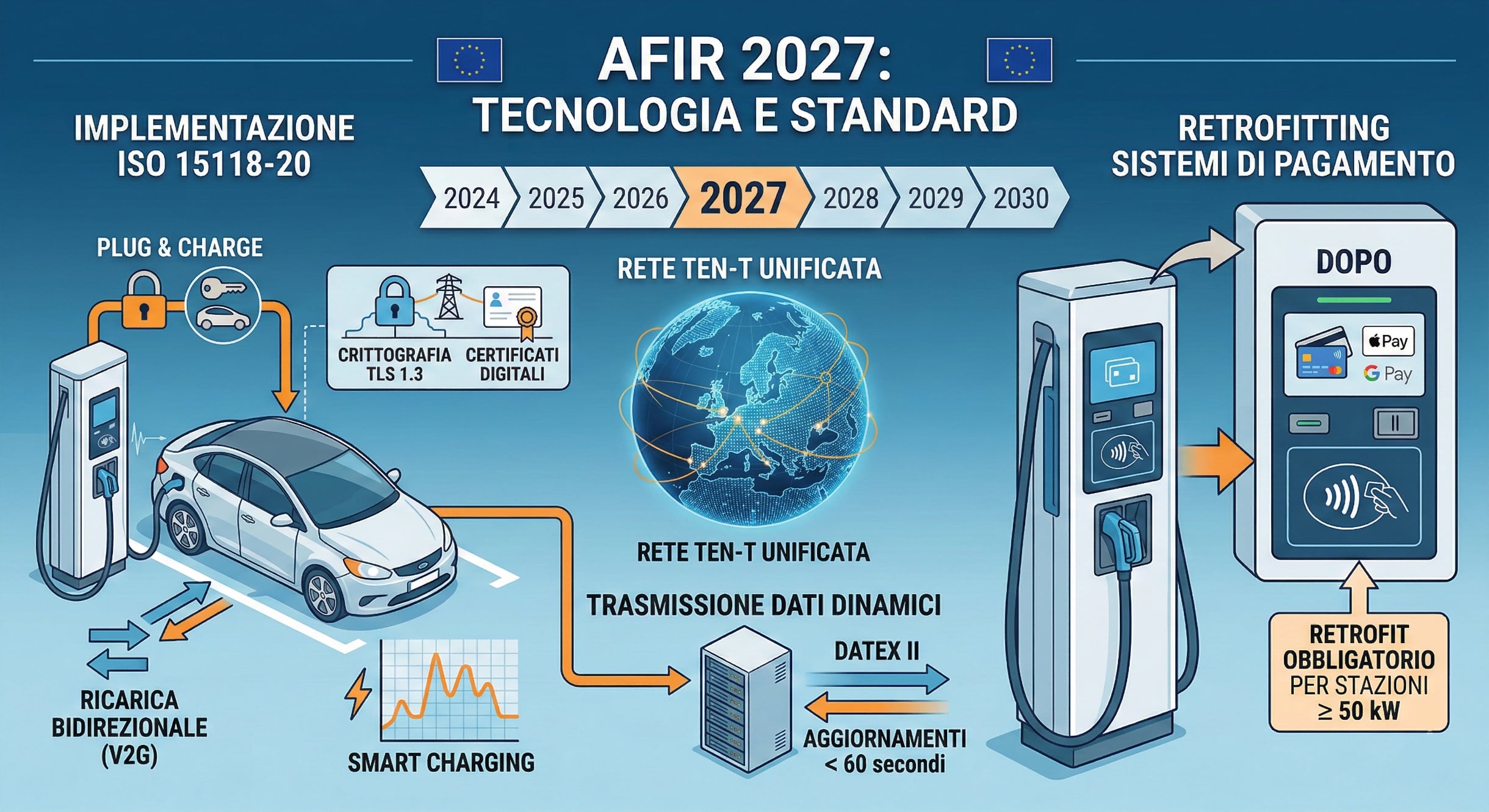
- Retrofitting (By January 1, 2027): All public charging stations with power equal to or greater than 50 kW installed before April 2024 along the TEN-T network or in safe parking areas must be retrofitted with card readers or contactless systems.
- Stations < 50 kW: The use of dynamic QR codes for secure digital payments is permitted.
Price Transparency
Prices must be clear and comparable. Operators cannot apply excessive or hidden roaming costs:
- The price per kWh must be displayed before the start of the session.
- Any fixed components (session fee) or time-based components (post-charge occupancy) must be explicitly stated.
3. Technical Standards and Interoperability: ISO 15118-20
From January 1, 2027, hardware and software requirements for new infrastructures will change:
- ISO 15118-20 Support: All new charging points (public and private Type 3/4) and renovated ones must support the ISO 15118-20 standard. This natively enables Plug & Charge (automatic charging without card/app) and bidirectional charging (V2G - Vehicle to Grid).
- Smart Charging: Digital communication becomes mandatory. Stations must be able to receive signals from the grid to modulate power, ensuring the stability of the electrical system.
4. Hydrogen and Maritime Infrastructures
Although many targets are set for 2030, 2027 includes intermediate reporting and planning milestones:
- Hydrogen: By 2030, refueling stations every 200 km on the TEN-T Core network, with a capacity of at least 1 ton/day and 700 bar pressure.
- Ports (OPS - Onshore Power Supply): By December 31, 2027, Member States must submit a detailed report on the installed capacity for shore-side electricity. The final obligation (2030) requires 90% of container and passenger ships over 5,000 GT to use quay-side electricity.
2027 Requirements Summary Table
| Scope |
Requirement By 01/01/2027 |
Technical Specifications |
| TEN-T Core Power |
Pool min. 600 kW |
At least 2 points ≥ 150 kW |
| Trucks (HDV) |
50% TEN-T network coverage |
2,800 kW pool; 350 kW points |
| Payments (Retrofit) |
Mandatory POS/Contactless |
For existing stations ≥ 50 kW |
| Protocols |
ISO 15118-20 |
Plug & Charge and Bidirectionality |
| Data |
DATEX II Standard |
Dynamic data transmission (availability) |
5. Sanctions and Monitoring
AFIR requires Member States to establish a "proportionate, effective, and dissuasive" penalty regime for operators who fail to comply with payment or data transparency requirements. Station availability data must be transmitted in real-time (within 1 minute of status change) to National Access Points (NAPs).
Technical Insight for CPOs and Installers
Here is a technical deep dive focused on the two most demanding and technologically advanced challenges posed by AFIR by 2027: the implementation of the ISO 15118-20 protocol and the hardware upgrade for payment systems.
Technical Focus: ISO 15118-20 Protocol ("Dash 20")
AFIR mandates that by 2027 new infrastructures support advanced digital communication standards. ISO 15118-20 is the evolution of the previous "Dash 2" and introduces features that transform the charging station from a simple dispenser into an intelligent node of the grid.
Key Technical Features:
- Plug & Charge (PnC): Uses a Public Key Infrastructure (PKI) and digital certificates exchanged between vehicle and charger via the TLS 1.2/1.3 protocol. The user plugs in the cable, and authentication/billing happens automatically without RFID cards or Apps.
- Bidirectional Charging (V2G - Vehicle to Grid): "Dash 20" natively supports energy transfer from the vehicle to the grid (V2G), to the home (V2H), or to the building (V2B). It includes support for both alternating current (AC) and direct current (DC) charging with dynamic power flows.
- Cybersecurity: Introduces mandatory strong encryption for all exchanged messages (V2G Message Transfer), protecting against "man-in-the-middle" attacks during the charging session.
- Dynamic Control Mode: Allows the grid (via the CPO) to send a "charging profile" to the vehicle, which can vary in real-time based on local electrical grid load.
Retrofitting Analysis for Payment Systems
Article 5 of AFIR is categorical: by January 1, 2027, rapid charging stations (≥ 50 kW) already existing on the TEN-T network must be equipped with card readers.
Challenges and Estimated Costs:
Retrofitting is not a simple addition of a module, but often involves structural revision:
- Hardware Integration: Many "legacy" chargers do not have pre-drilled slots or internal space for PCI-PTS certified payment terminals.
Estimated hardware cost: €800 - €1,500 per terminal (e.g., vandal-proof contactless readers).
- Software Integration and Connectivity: The charger controller must communicate with the payment gateway. If the firmware is not upgradeable, the entire controller must be replaced.
Estimated labor and integration cost: €500 - €1,200 per site.
- Operating Costs (OpEx): Adding a POS involves bank commissions (0.5% - 2%) and encrypted data connection costs (dedicated M2M SIM).
Overall Impact: It is estimated that the total cost for retrofitting a single station can range between €2,000 and €4,500. For an operator with a network of 1,000 rapid charging points, the investment by 2027 could exceed 3 million euros just for payment systems.
Dynamic Data Transmission (DATEX II)
AFIR requires that by 2027 charging point availability be transmitted in real-time.
- Specifications: Data must follow the DATEX II protocol (European standard for traffic information exchange).
- Mandatory Data:
- Operational status (in service/out of service).
- Availability (occupied/free).
- Current "ad hoc" price.
- Latency: Status changes must be updated in National Access Points (NAPs) with a maximum latency of 60 seconds.
Conclusion
2027 marks the end of the "experimental" charging era. For CPOs, this means a massive hardware upgrade campaign (for payments) and software upgrade (for ISO 15118-20). For the end-user, the result will be a charging experience similar to traditional refueling, but with infinitely superior digital integration.











Leave a Comment