Introduction to Power Analysis
With the growing demand for efficient, safe, and stable power supplies in electronic products, testing power supply performance has become crucial. The power analysis function of an oscilloscope helps engineers quickly measure and analyze power-related parameters (such as switching loss, efficiency, ripple, etc.), thereby improving test efficiency and optimizing power supply design. This guide will introduce how to use an oscilloscope to complete the power analysis test.
The power analysis test of the oscilloscope can achieve the following goals:
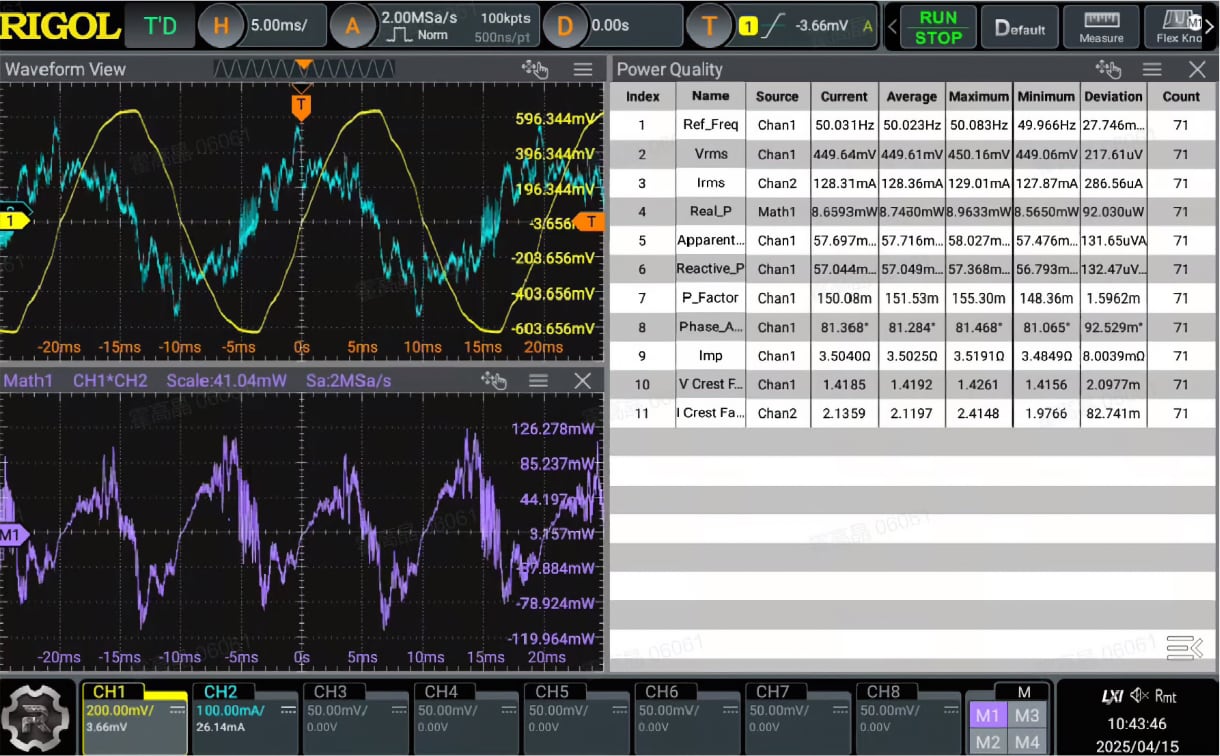
- Evaluate power quality, including the stability and ripple level of the output voltage/current.
- Check harmonics, modulation, and dynamic transient response to analyze the power supply's performance under various operating conditions.
- Measure switching loss, slew rate, and power efficiency to optimize energy efficiency and thermal management.
- Verify the Safe Operating Area (SOA) of switching devices and monitor turn-on/turn-off and inrush current to enhance the system safety and reliability.
- Perform deskew calibration to ensure all measurement data is accurate and reliable.
Introduction to the Power Analysis Software Function
RIGOL MHO/DHO5000 series oscilloscope provides the optional power analysis function, which enables users to efficiently analyze key indicators of switching power supplies, such as efficiency and reliability. The power analysis function supports various measurement and analysis items, such as power quality, ripple, switching loss, modulation analysis, transient response, slew rate, power efficiency, turn-on/off, inrush current, harmonic analysis, and Safe Operating Area (SOA) test.
To ensure the smooth test of the above items, the oscilloscope provides connection diagrams for each test and displays complete measurement results, helping users perform power analysis tests quickly and correctly.
Introduction to Working Principle
The power analysis function automatically performs delay deskew and offset calibration by synchronously acquiring voltage and current signals at key points. With the built-in algorithms, the oscilloscope analyzes these signals and automatically calculates key metrics such as ripple, harmonics, loss, efficiency, and more. These measurement results are then displayed intuitively through graphs or numerical values, helping users quickly identify and locate issues in the power supply design.
RIGOL MHO/DHO5000 series digital oscilloscopes provide a full suite of power analysis functions, including power quality analysis, conversion efficiency, output ripple measurements, and so on. With the oscilloscope and a DC electronic load, engineers can perform comprehensive power supply quality tests quickly. It replaces the traditional test methods that uses the power analyzer and complex software, reducing the test costs significantly.











Leave a Comment